
Feedback that Travels: 5 Moves for Cross-Cultural Teams
“I want to tell the truth without making enemies.”
I’ve heard versions of that sentiment in Lagos and London, Nairobi and New York – different accents, same hesitation. A senior director in Johannesburg rewrites bullets of concern to her manager three times before a video call…then deletes them all. Friction grows. A country lead in Slovenia watches a colleague repeatedly interrupt partners on Zoom but says nothing, assuming someone senior will intervene. Cracks turn to fissures. Ultimately, the silence costs more than the conversation would.
This past year, across multiple cohorts of managers and senior leaders in 22 countries, I’ve been invited into the charged moments when a team decides to name a challenge…or let it fester.
Where things fall apart
No matter the geography or cultural context, these three fractures widen precisely when we’re deciding whether to speak up:
Power erases precision. In steep hierarchies, even well-meant notes land as verdicts. People calculate risk before contributing, and psychological safety collapses.
Culture overwrites clarity. “Direct” in one context reads as disrespect in another; “careful” can look like evasion. Feedback style isn’t universal – it’s mapped by culture, power, and context.
Delay erodes trust. We pile on too much at once, wait too long to name it, or never close the loop. Distributed teams only amplify this erosion unless leaders design for distance of title, language, location, and relationship.
This global pattern requires a portable fix.
A five-step approach
As miscommunication abounds on increasingly hybrid and distributed teams, leaders that deliberately design for candor outperform those that don’t. Under pressure, try five small moves — fast enough for impromptu peer check-ins, sturdy enough for planned upward conversations:
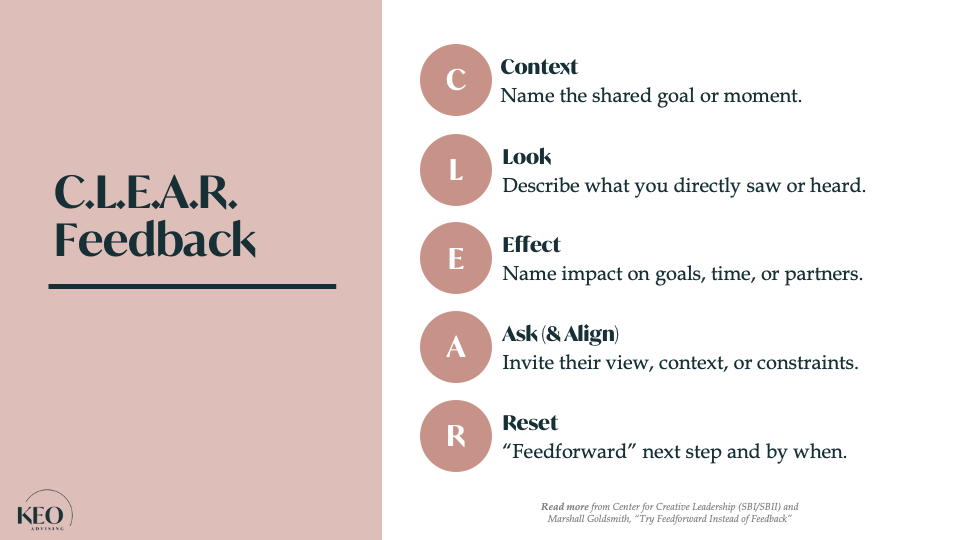
Two design choices keep the CLEAR framework portable across roles and seasons:
The just-right sequence depends on stakes and hierarchy, turning CLEAR into CLERA or CLERRA to meet the moment.
When stakes are high, speed matters more than extensive dialogue.
CLEAR → CLERA (Context, Look, Effect, Reset, Ask briefly)
Quickly reset with a next step then ask one clarifying question.When power is uneven, preserve dignity and agency by proposing multiple paths forward.
CLEAR → CLERRA (Context, Look, Effect, Reset with options, Ask)
Reset by offering a few, viable next steps before asking for perspective.No matter the contextual sequence, end with a confirmation of who does what by when, focusing on the next behavior rather than the last grievance.
Cadence makes it culture. Though the first exchanges may feel awkward, consistency alone fosters transformation.
Start biweekly peer swaps (15 minutes) to practice the moves.
Layer monthly staff↔manager swaps to catch cracks before they become chasms.Small, predictable, repeatable.
What it sounds like
To prep for a follow-up call with a grantee partner, a colleague addressed a misstep with a peer:
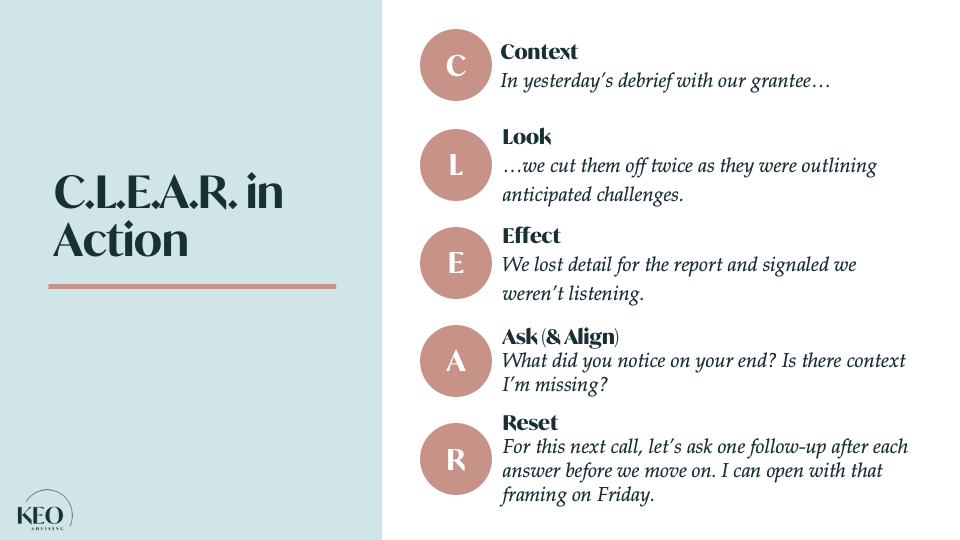
Five field-tested steps. Specific and forward-focused.
What comes next
Effective implementation lives in the details:
Practicing the moves across real scenarios: peer to peer, staff to manager, low stakes to high
Mapping the decision points: when to flip the order, how to adapt phrasing across cultural contexts, what cadence makes feedback routine
Organizations that invest in those details see the shift: fewer escalations up the hierarchy, faster resolution of cross-regional friction, and teams that can confidently “say the thing” without making enemies.
Selected Sources
Amy C. Edmondson, “Psychological Safety Comes of Age,” Annual Review of Organizational Psychology and Organizational Behavior (2023).
Erin Meyer, The Culture Map: Breaking Through the Invisible Boundaries of Global Business, PublicAffairs (2014/2016 eds).
Tsedal Neeley, “Global Teams that Work: A Framework for Bridging Social Distance (SPLIT),” Harvard Business Review (2015); and Remote Work Revolution: Succeeding from Anywhere, Harper Business (2021).
When the room is tense, leaders need moves that carry across titles, cultures, and time.

